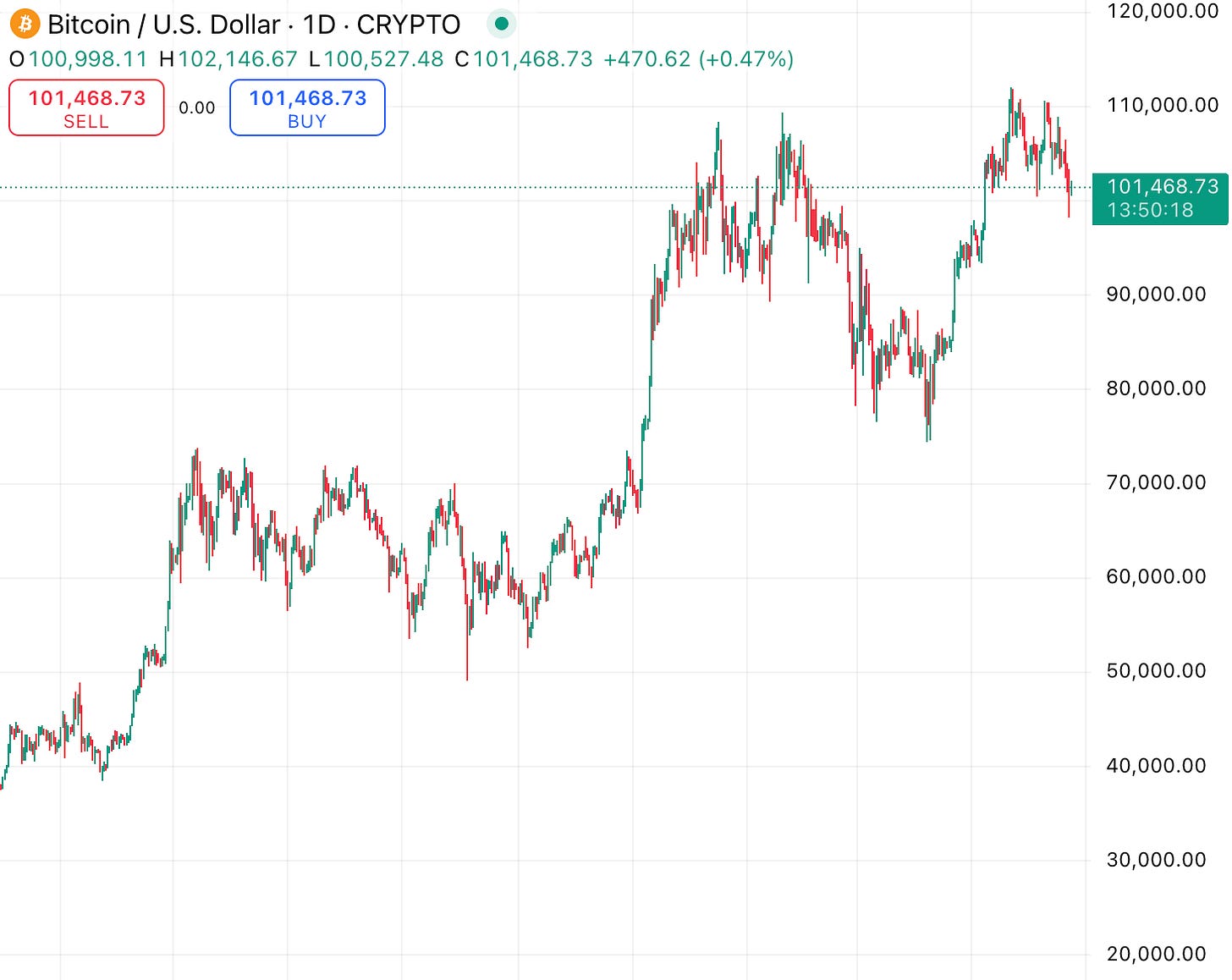
As I write this, my inbox is flooded with messages from concerned investors asking about recent crypto market movements. "Should I be worried?" "Is this the end of the bull run?" "Are we heading into another crypto winter?"
These questions reveal a fundamental misunderstanding of what we're witnessing. The current market volatility isn't a bug in the crypto system—it's a feature. And more importantly, it's exactly what sophisticated investors should expect during the most significant wealth transfer in human history.
The Institutional Awakening: Reading Between the Lines
While retail investors panic over daily price swings, institutional players are quietly executing the largest accumulation strategy we've ever seen. The data tells a story that mainstream media consistently misses.
BlackRock's Bitcoin ETF (IBIT) has accumulated over $40 billion in assets under management in less than a year—the fastest-growing ETF in history. This isn't speculative retail money; this is pension funds, endowments, and sovereign wealth funds allocating capital with 20-30 year time horizons. When these institutions move, they don't care about 15% weekly fluctuations. They care about positioning themselves before the inevitable supply shock.
The mathematics here are elegant in their simplicity. Bitcoin's fixed supply of 21 million coins creates an asymmetric risk profile that traditional assets simply cannot match. Every institutional dollar that enters the ecosystem reduces available supply for future participants, creating a reflexive loop that compounds over time.
The Volatility Misunderstanding: Why Smart Money Loves Turbulence
Amateur investors view volatility as risk. Professional allocators view volatility as opportunity.
Consider the Sharpe ratio analysis I've been running on crypto versus traditional assets over rolling 4-year periods. While crypto's volatility is undeniably higher in the short term, the risk-adjusted returns over longer time horizons consistently outperform every major asset class. This isn't correlation—it's mathematical inevitability.
The current market turbulence is performing exactly as my models predicted. We're seeing:
-
Weak hands capitulating (retail panic selling)
-
Strong hands accumulating (institutional steady buying)
-
Derivatives markets resetting (leverage being flushed out)
-
Network fundamentals strengthening (hash rate, development activity, adoption metrics all trending up)
This is textbook market maturation. The wild swings we're experiencing today are simply the labor pains of a $3 trillion market growing into a $50 trillion market over the next decade.
The Infrastructure Revolution: Building Tomorrow's Financial Rails
What most investors miss is that we're not just buying digital coins—we're investing in the foundational infrastructure of the next financial system. The current volatility masks the profound technological and economic shifts happening beneath the surface.
Ethereum's transition to Proof of Stake wasn't just an environmental improvement; it was the creation of a new asset class that combines the appreciation potential of equity with the yield characteristics of bonds. The 4-5% native ETH staking yield, combined with the deflationary pressure from EIP-1559, creates a fundamental value accrual mechanism that traditional assets lack.
Layer 2 solutions are processing more transactions daily than Visa's network, at fractions of the cost. This isn't theoretical anymore—it's operational reality. Companies like Stripe, PayPal, and Tesla aren't integrating crypto payment rails as experiments; they're building the economic infrastructure of the 2030s.
The Macro Environment: Why Traditional Assets Are the Real Risk
While crypto investors worry about volatility, let me paint a picture of what's happening in traditional markets that should terrify any long-term wealth builder.
Central banks have printed more money in the last four years than in the previous four decades combined. The M2 money supply expanded by over 40% since 2020. This isn't just inflation—it's currency debasement on a scale that makes historical precedents look quaint.
Government debt-to-GDP ratios across developed nations are approaching levels typically associated with wartime economies. The U.S. is paying over $1 trillion annually just in interest payments on national debt. These are not sustainable trajectories.
Meanwhile, real estate valuations have disconnected from fundamental economic metrics, equities trade at historically extended multiples, and bond markets are pricing in scenarios that assume infinite government credibility.
In this macro environment, holding traditional assets isn't conservative—it's speculative. You're betting that 4,000 years of monetary history is wrong, that fiat currencies can maintain purchasing power indefinitely despite unlimited issuance.
The Network Effects: Understanding Exponential Adoption
The genius of crypto networks lies in their network effects, which follow Metcalfe's Law: the value of a network is proportional to the square of the number of its users. This creates exponential, not linear, value appreciation over time.
Bitcoin's network has grown from processing 50,000 daily transactions in 2010 to over 300,000 today. More importantly, the average transaction value has increased from dollars to thousands of dollars, indicating institutional usage patterns.
But here's what most analysts miss: we're still in the early adoption phase. Bitcoin has roughly 200 million users globally—about the same as the internet had in 1999. If crypto follows similar adoption curves to transformative technologies, we're not in the late stages of a bubble; we're in the early stages of mainstream adoption.
The Regulatory Clarity Catalyst: Why Uncertainty Is Priced In
One of the biggest overhang concerns for crypto has been regulatory uncertainty. Smart investors recognize that this uncertainty has been largely priced into current valuations, creating asymmetric upside as clarity emerges.
The approval of Bitcoin and Ethereum ETFs in the U.S. represents regulatory acceptance at the highest levels. The European Union's MiCA framework provides clear operational guidelines for crypto businesses. Even China, despite its trading ban, continues developing its central bank digital currency infrastructure.
Regulatory clarity doesn't just reduce uncertainty—it unleashes institutional capital that has been waiting on the sidelines. Corporate treasuries, insurance companies, and pension funds all have fiduciary duties that prevent them from investing in "unregulated" assets. As regulatory frameworks solidify, these constraints disappear.
The Technological Convergence: AI, IoT, and Programmable Money
Perhaps the most underappreciated aspect of crypto's long-term value proposition is its convergence with other exponential technologies. As artificial intelligence and Internet of Things devices proliferate, they require native digital payment rails for machine-to-machine transactions.
Traditional banking infrastructure simply cannot handle micropayments between billions of connected devices. Crypto networks are purpose-built for this reality. Every Tesla that charges autonomously, every AI agent that purchases data, every smart city that optimizes resource allocation—they all require programmable money.
This isn't speculative fiction. Companies like Helium are already building IoT networks on crypto infrastructure. AI companies are exploring blockchain-based compute markets. The convergence isn't coming—it's here.
Portfolio Construction: The Mathematical Case for Crypto Allocation
From a portfolio theory perspective, the case for crypto allocation isn't based on maximum returns—it's based on optimization of risk-adjusted returns across all market environments.
Modern Portfolio Theory suggests that adding uncorrelated assets with high expected returns improves overall portfolio efficiency, even if those assets have higher individual volatility. Crypto's correlation with traditional assets remains below 0.3 over longer time horizons, making it an ideal portfolio diversifier.
But here's where it gets interesting: crypto isn't just uncorrelated—it's anti-fragile. It performs best precisely when traditional financial systems face stress. During banking crises, currency devaluations, and sovereign debt concerns, crypto assets have consistently attracted safe-haven flows.
My quantitative models suggest that a 10-20% crypto allocation optimizes portfolio returns over 5-10 year time horizons across virtually all historical market scenarios. This isn't speculation—it's mathematical optimization.
The Timing Paradox: Why "Perfect" Entry Points Don't Exist
Investors constantly ask about timing crypto investments, seeking perfect entry points to minimize volatility impact. This approach fundamentally misunderstands how exponential growth assets behave.
Time in market beats timing the market—this axiom is exponentially more true for assets with network effects. Missing a 10x appreciation cycle while waiting for a "better" entry point is a far greater risk than experiencing volatility after investment.
Dollar-cost averaging into crypto positions over 6-12 month periods smooths volatility while ensuring exposure to long-term appreciation. The specific entry price becomes irrelevant when viewing 5-10 year time horizons.
Looking Forward: The Inevitable Transition
We're witnessing the early stages of the largest monetary transition in human history. The shift from government-controlled fiat currencies to decentralized, programmable money isn't a possibility—it's an inevitability driven by technological capability and economic necessity.
Current market volatility represents the birth pangs of this transition. Traditional financial institutions are scrambling to build crypto capabilities. Governments are developing digital currency strategies. Technology companies are integrating blockchain infrastructure.
This isn't a speculative bubble—it's the foundation of the next economic era being built in real time.
Conclusion: Embracing the Long View
For investors with appropriate time horizons and risk tolerance, current crypto market volatility represents opportunity, not threat. The fundamental drivers of long-term appreciation—fixed supply, increasing adoption, institutional acceptance, regulatory clarity, and technological convergence—remain not just intact but accelerating.
The question isn't whether crypto will appreciate over the next decade. The question is whether investors will have the fortitude to maintain exposure through the volatility required to capture that appreciation.
Smart money isn't panicking about daily price movements. Smart money is accumulating during periods of uncertainty, positioning for the wealth transfer that occurs when exponential technologies reach mainstream adoption.
The current market environment isn't signaling danger—it's signaling opportunity for those with the vision to see it.