Apparently, another way to make data center money is to mine Zcash.
That was my reaction to an August comparison putting Zcash mining ahead of Bitcoin mining and an AI computing benchmark on revenue per megawatt. Then I looked at what two companies were paying for the machines, and the more interesting story became how much you should pay to start earning sooner.
I’ve discussed Cypherpunk Technologies before, as its mining acquisition adds an operating business to its Zcash treasury exposure, and the price initially looks steep. CYPH acquired 4,902 machines on August 17 for roughly $6,800 per machine equivalent. Fortitude contracted for 9,000 new machines at $3,499 each. Both use Bitmain’s Antminer Z15 Pro, so why pay nearly twice as much?
Part of the difference is what came with the purchase. CYPH bought an operating fleet, hosting agreements, deposits and related assets. Fortitude’s price is for equipment, with 3,000 machines scheduled to ship in October and another 6,000 in November 2026. Fortitude already mines Zcash; it is this expansion that has to wait.
While a machine is awaiting delivery, an operating one can already be earning. The cheaper purchase could still be the better deal, but the sticker price leaves out the income forgone along the way. How much is that head start worth?
I tried putting some numbers around it by removing CYPH’s $782,668 of identified hosting deposits and prepayments brings its package cost to about $6,640 per machine, leaving a $3,141 gap against Fortitude’s $3,499 equipment price. Hosting rights and other assets still make this an imperfect comparison, but it gives us a gap to test against earlier earnings.
The chart shows how much 60, 90 or 120 days of production could contribute toward that gap. It’s an illustration, not CYPH’s reported earnings.
Assumptions: ZEC at $1,000; network computing power of 30 GSol/s; 95% uptime; a 2% pool fee; and electricity plus hosting at $0.07 per kilowatt-hour.
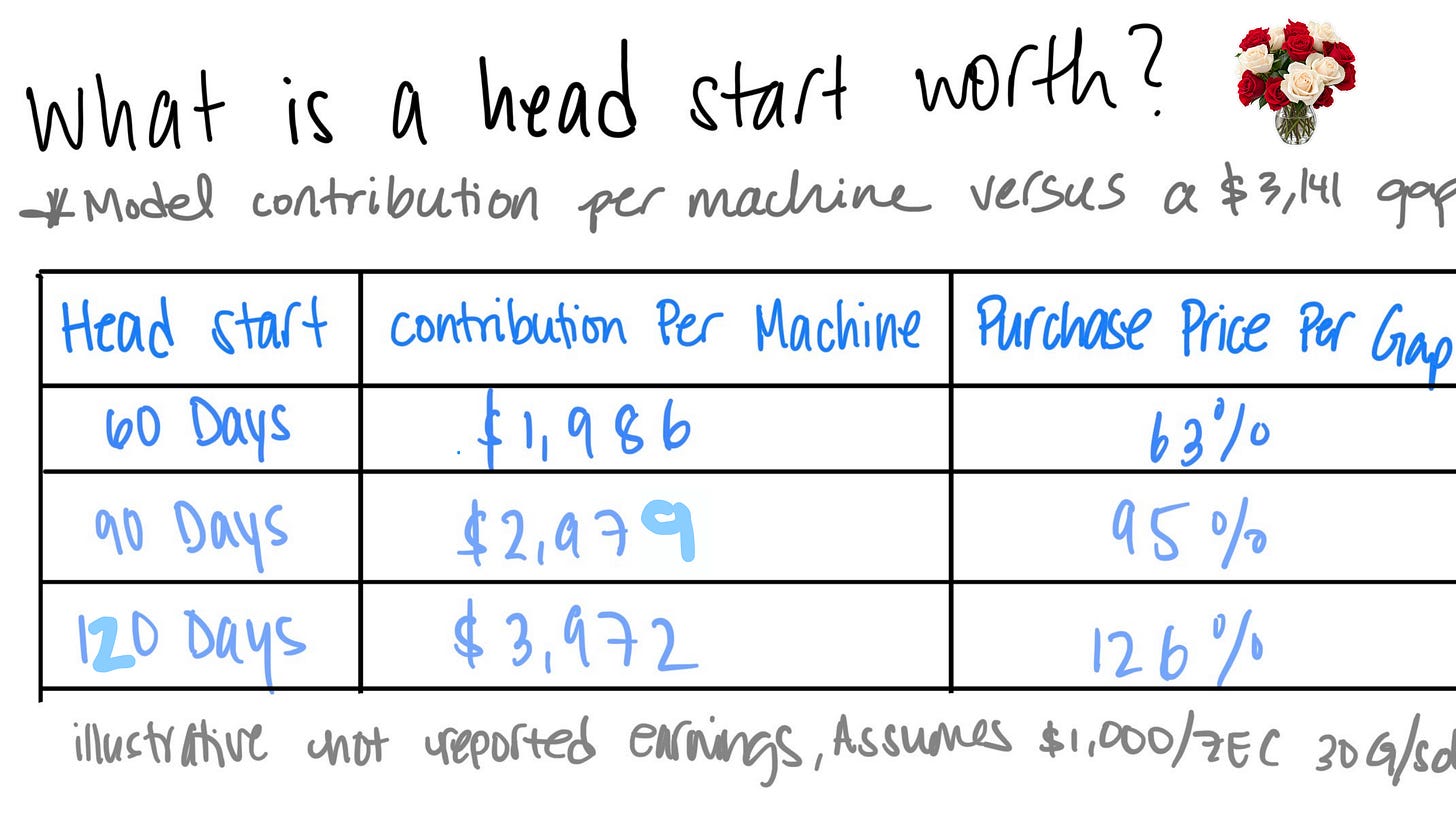
Ninety days produces about $2,979 in contribution per machine under those assumptions, covering roughly 95% of the gap. That is before overhead, repairs, financing, taxes and recovering the equipment investment though this doesn’t prove CYPH bought a bargain, but it shows why paying more for machines that are already running can make sense.
The trouble is that the opportunity attracting these buyers also attracts competitors, as more machines divide roughly the same scheduled pool of Zcash rewards, so the earnings in my chart won’t necessarily last. If Fortitude’s entire order adds its rated 7.56 GSol/s to the assumed 30 GSol/s network, with nothing else changing, revenue per unchanged machine falls about 20%. ZEC would have to rise approximately 25% just to offset that. Actual deliveries, uptime and other miners entering or leaving will change the outcome.
Bitcoin has been wrestling with this relationship since its earliest days. In 2009, NewLibertyStandard actually based its quoted exchange rate on electricity costs. But a mature market doesn’t promise to reimburse miners: later research argues that mining costs follow Bitcoin’s price, as higher prices draw in more equipment and competition. Spending more to mine a coin doesn’t guarantee someone will pay more for it.
Being right about Zcash’s price can still leave a mining investor disappointed. The coin might rise while each machine earns fewer coins, and the company can expand while each shareholder owns a smaller slice.
CYPH’s deal brings that last point home. It financed the acquisition with pre-funded warrants. Counting common shares and existing pre-funded warrants, the transaction adds roughly 23% to the economic share count, assuming the new warrants become fully exercisable and excluding other warrants and stock awards. That calculation uses the pre-acquisition share figures. Shareholders receive mining assets in return, so dilution alone doesn’t establish that value was lost. Those assets do, however, have to earn enough to justify the larger share count.
What I want to see next is when Fortitude’s new machines actually start producing, what both companies pay for electricity and hosting, and how much ZEC remains per share after the bills. Those results will help us judge whether buying earlier or buying cheaper paid off.
That’s what makes this more interesting to me than another impressive mining revenue figure. Paying more to start sooner can be worthwhile. The question is how much of that head start ultimately reaches the shareholder.
Enjoy this image of some flowers on my table

Beautiful flowers in Boston Common

Not the best photographer, but I discovered these tall flowers are Cannas (Canna lillies) and find them beautiful.