In the rapidly changing world of financial innovation, where traditional assets meet the volatile frontier of cryptocurrencies, MicroStrategy (MSTR), now officially rebranded as "Strategy" (per August 11, 2025) to emphasize its Bitcoin focus, has launched its latest creation: STRETCH, ticker STRC. Rolled out in July 2025 as a perpetual preferred stock offering, STRETCH promises investors an appealing combination of stability and yield, with an initial 9% variable-rate cumulative dividend paid monthly, all backed by the company's massive Bitcoin treasury, which now exceeds 600,000 BTC.
Designed to trade near a $100 par value, it's positioned as a "high-yield, Bitcoin-backed money-market-style vehicle," allowing indirect exposure to Bitcoin without the hassle of direct custody or the wild swings of spot trading. At first glance, this looks like a smart move from Michael Saylor's playbook: a way to monetize MSTR's Bitcoin holdings while funding further acquisitions, potentially creating a self-reinforcing cycle of leverage and growth.
But as any experienced investor knows, perfect investment vehicles don't really exist outside of marketing materials. STRETCH, despite its clever design, comes with structural challenges, embedded risks, and opportunity costs that are worth examining closely. Drawing on principles from behavioral finance, capital structure theory, and historical precedents in leveraged asset plays, let's explore where STRETCH might fall short.
This isn't about condemning the product, but rather providing a thorough analysis to help investors make informed decisions. Think of it as a careful examination: acknowledging the vehicle's strengths while also revealing its vulnerabilities.
I am not a Strategy shareholder, nor a shareholder of one of its competitors.
At its heart, STRETCH extends MSTR's aggressive Bitcoin accumulation strategy, which has seen the company raise billions through debt and equity to build its digital gold reserves. The proceeds from STRC's $2.8 billion initial offering (part of a broader $4.2 billion at-the-market program) are explicitly earmarked for more Bitcoin purchases. This creates a leveraged feedback loop: higher Bitcoin prices boost MSTR's balance sheet, supporting dividend payments and attracting more capital. But what happens in a downturn? The consequences could be significant. Consider the numbers. MSTR's Bitcoin holdings, valued at over $71 billion at launch, underpin STRETCH's appeal. Yet Bitcoin's historical volatility, with standard deviation often exceeding 50% annually, means a 30-50% drawdown (like we saw in 2022) could seriously impact the company's equity cushion.
Preferred stockholders like those in STRC sit senior to common equity but junior to debt holders. In a liquidity crunch, dividends could be deferred (though cumulative, they accrue without interest), and redemption becomes uncertain since it's perpetual with no maturity date. This concern is grounded in established financial theory, where leverage increases returns in bull markets but magnifies losses in bear markets. MSTR's debt-to-equity ratio, already stretched from prior convertible notes, amplifies this dynamic. Some analysts have noted that STRETCH "may be extending itself too far," echoing concerns from earlier offerings. Unlike a true money-market fund, which invests in low-risk treasuries, STRETCH's "backing" is a speculative asset class. Investors seeking stability might find themselves walking a tightrope, where the 9% yield is compensation for what's essentially equity-like risk in disguise.
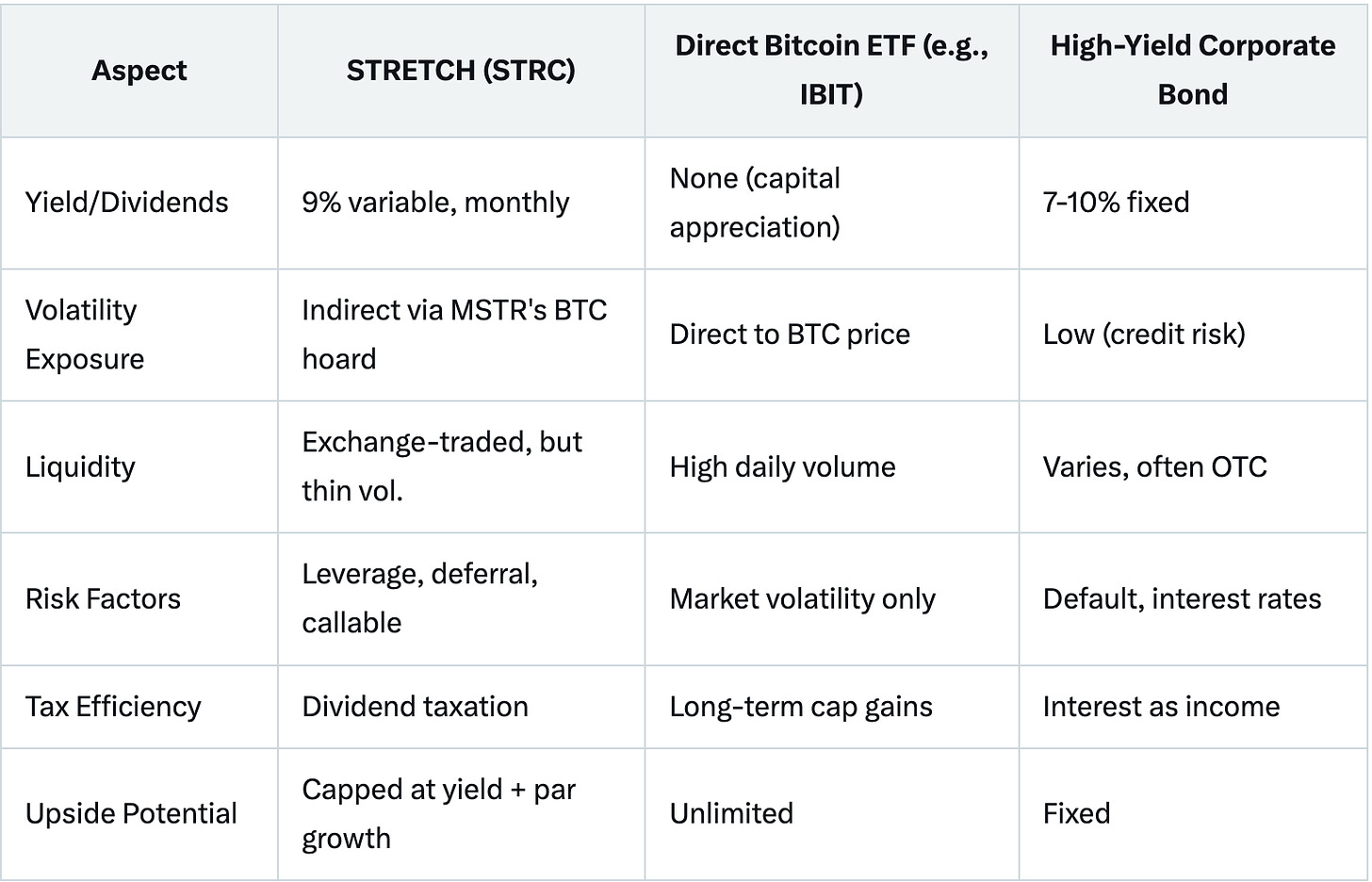
STRETCH's variable-rate dividend, starting at 9% but adjustable based on market conditions, sounds flexible, but it cuts both ways. In a rising interest rate environment (still possible given ongoing inflation concerns), the yield could climb, benefiting holders. But what if rates fall or Bitcoin's implied funding costs drop? The rate is tied to factors like Bitcoin's performance and MSTR's cost of capital, which adds complexity.
We've seen this before: Variable-rate preferreds from energy firms in the 2010s often underperformed during commodity slumps, as yields reset lower amid distress. Here, the dividend accumulates cumulatively, but without a floor, it could dip below inflation-adjusted returns. At 9%, it beats current 10-year Treasuries (around 4-5% in mid-2025), but you have to factor in Bitcoin's opportunity cost. Direct BTC holders capture full upside appreciation; STRETCH caps you at dividends plus potential par appreciation, minus the drag of MSTR's operational overhead. The tax situation also matters: Qualified dividends are taxed at capital gains rates, but if deemed non-qualified due to the variable nature or Bitcoin linkage, ordinary income rates apply, up to 37% for high earners. This erodes net yield, making STRETCH less efficient than tax-advantaged vehicles like municipal bonds or direct crypto in Roth IRAs.
Investment vehicles depend heavily on their management. STRETCH puts your capital in the hands of Michael Saylor's unwavering Bitcoin commitment, a philosophy that's delivered spectacular returns (MSTR up 500%+ since 2020) but represents a concentrated bet. With no voting rights (standard for preferreds), investors are essentially passengers. What if regulatory challenges increase? The SEC's evolving stance on crypto could classify MSTR's treasury as a security, triggering forced sales or compliance costs. Or consider operational risks: while cold storage makes hacks unlikely, they're not impossible (remember Mt. Gox).
STRETCH's prospectus likely includes call provisions, allowing MSTR to redeem at par plus accrued dividends if conditions favor, potentially limiting upside in a Bitcoin rally. From a behavioral finance perspective, this highlights a classic principal-agent dynamic: Saylor's incentives align more with common shareholders (where he has a massive stake) than preferred holders. If Bitcoin tanks, he might prioritize debt servicing over dividends, deferring payments to preserve liquidity for more purchases.
Why choose STRETCH when alternatives exist? Direct Bitcoin ETFs (like IBIT, FBTC) offer pure exposure without corporate complexity, with lower fees and better liquidity. Leveraged MSTR ETFs like MSTX provide amplified upside (1.75x daily) for risk-tolerant traders, though with decay risks. Even traditional high-yield bonds or REITs yield 7-10% with tangible assets backing them. STRETCH's "money-market-style" positioning targets stability seekers, but as online discussions suggest, it might be more of a yield trap for those who underestimate tail risks. In efficient markets theory, its premium yield reflects compensation for illiquidity and complexity, not a free lunch.
Looking at the bigger picture, Bitcoin's correlation with risk assets (0.6+ to Nasdaq) means STRETCH could struggle in recessions, precisely when dividends might be most needed. If adoption stalls or new technological threats emerge, MSTR's "Bitcoin Treasury Company" model faces challenges. We've seen similar stories with leveraged buyout firms in the 1980s (think RJR Nabisco) where debt-fueled empires faced pressure. In conclusion, STRETCH represents a creative tactical innovation, bridging traditional finance and crypto.
But it's not without its challenges. It offers volatility amplification, yield uncertainty, governance limitations, and faces competition from alternatives that might better suit many investors' needs. As Nassim Taleb might say, investors should seek assets that thrive on chaos, not ones stretched thin by it.
The key is to proceed with clear understanding; recognizing both the innovation and the imperfections, not chasing illusions.