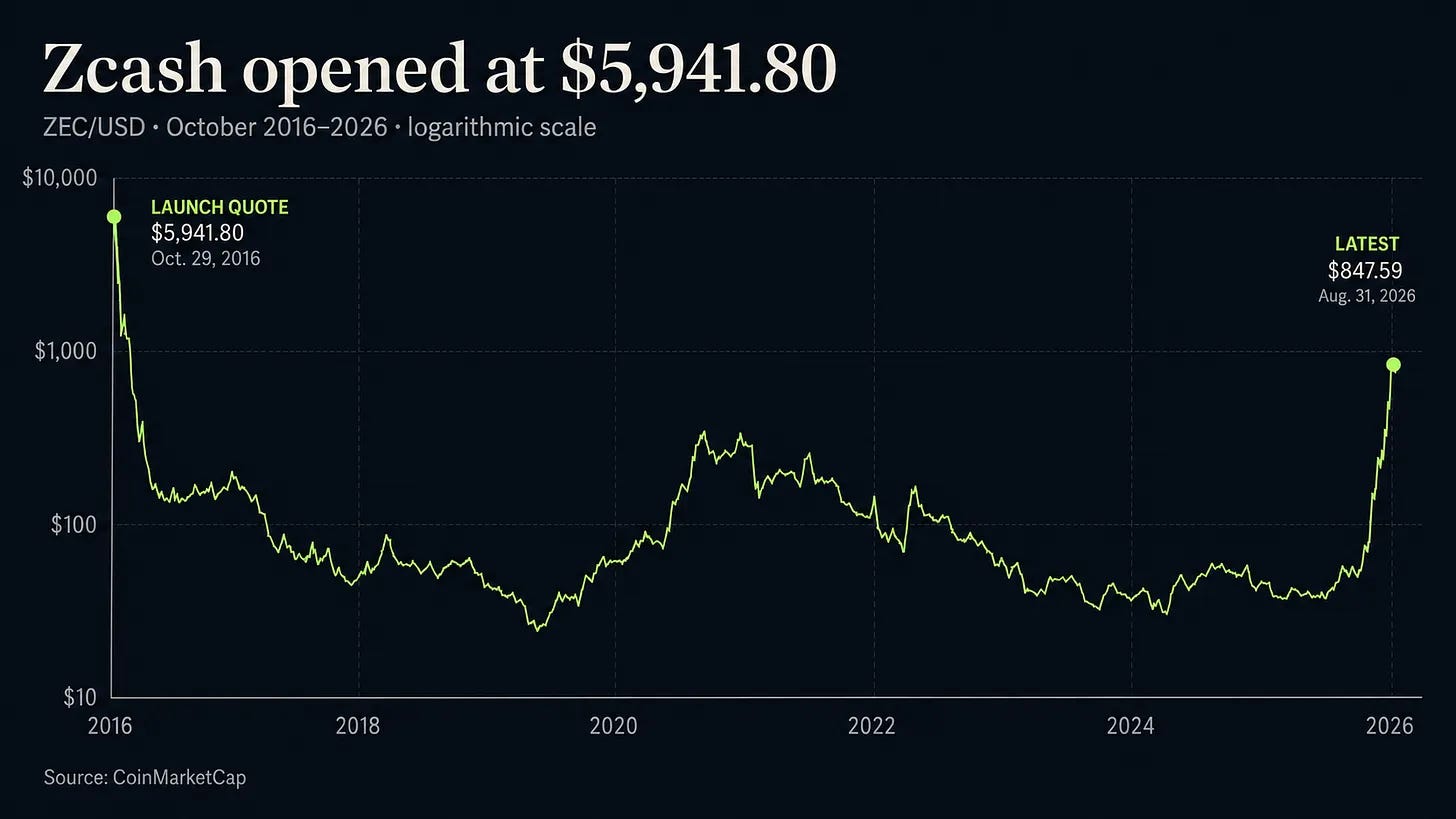
ZCash first launched on Oct. 28, 2016, to which if I wasn’t such a Bitcoin maximalist at the time would’v been a perfect time for me to invest, but I wouldn’t have predicted was how rapidly ZCash would rise hitting $4,000 to $5,900 shortly after launch.
During the 2017-18 bull market, ZCash ranged from $300-$900, and due to heavy supply growth without durable demand in the following bull markets it wasn’t able to recover beyond $700 until 2025. After ZCash’s issuance fell from 3.125 to 1.5625 per block, demand simply had less newly mined supply to absorb.
By October 10th, ZCash had risen almost 470% over 30 days from $40 to $230.
Amplification
While influencers massively drove crypto prices, the Winklevii recapitalized an already existing Cambridge biotech company, Leap Therapeutics (LPTX) to and converted it into a ZCash treasury vehicle , which provided it with immediate Nasdaq access without needing to IPO. Initially CYPH purchased 203,775 ZEC and by August 11 they had acquired 323,394, or about 1.4% of circulating supply, and is now shooting for 5% of total.
Grayscale opted to file its S-3 on Nov. 26th, ushering in even more trading activity.
ZCash’s rise intrigues me as there are other privacy assets out there that are also popular, one of them being Monero, frankly there has been little to no investment into bringing Monero onto Wall Street and that says, inherently - that there is far more investor appetite for ZCash instead.
ZCashs mix of transparent and shielded addresses allows regulated holders to use ZEC while maintaining an auditable public transaction path if it wants one and the privacy tech operates above as an additional capacity, whereas Monero is far more absolutist about its privacy, making it far harder for a financial institutions compliance department.
Interestingly enough, in January 2021 Grayscale formed a Grayscale Monero Trust (XMR) as a Delaware statutory trust and publicly listed Monero among the assets that it was evaluating for future products, but never launched it, later becoming the Grayscale Dogecoin Trust (DOGE).
Monero is not banned in the United States, but there is no straightforward way for Wall Street to package it.
Zen
Horizen originally supported shielded/private transactions using ZK-SNARKS, but after governance votes Horizen removed private transactions from the network due to regulatory concerns, then migrating onto Base as an ERC-20 token and the old Horizen mainchain was sunset. This still gives Horizen as an option for infrastructure/applications that can use zero knowledge privacy, though this structure separates it from Monero (XMR) where the monetary asset itself is private.
Grayscales $HZEN has absolutely been forgotten about by investors likely close to being delisted. Granted most aren’t aware or care about Zens existence.
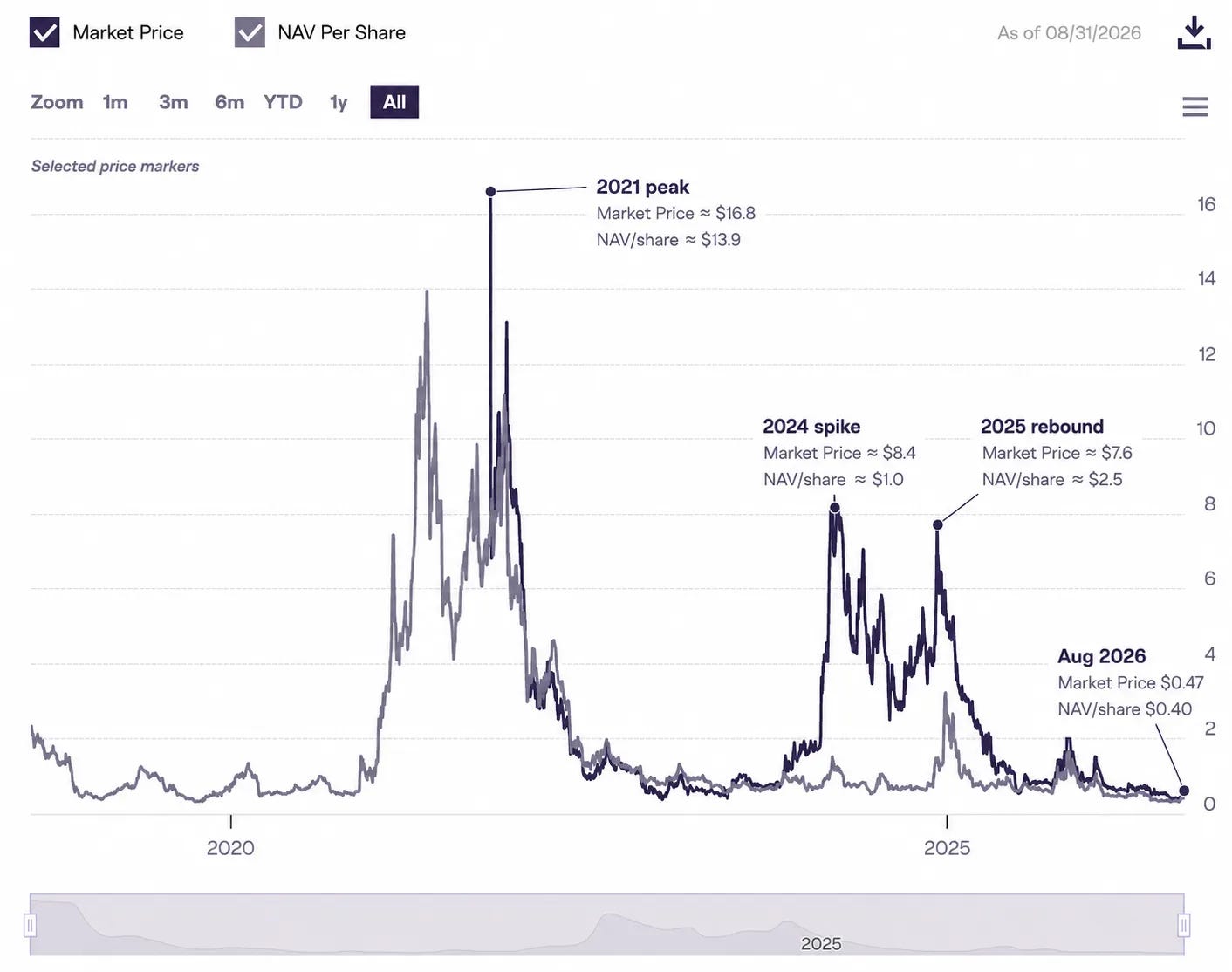
Official Grayscale chart from their site, I added prices on top.
Part of me wonders whether going to Base took all hype out of the coin and now traders are focusing on Horizen as an infrastructure company, evaluating it based on how many people are actually using this infrastructure.
ZCash is the only major privacy asset that is legible to regulated capital markets, and for that reason we’ll likely see it rise into the thousands in the coming months (NFA).
I’m a huge fan of ZCash as a project and am excited to see where it goes from here.